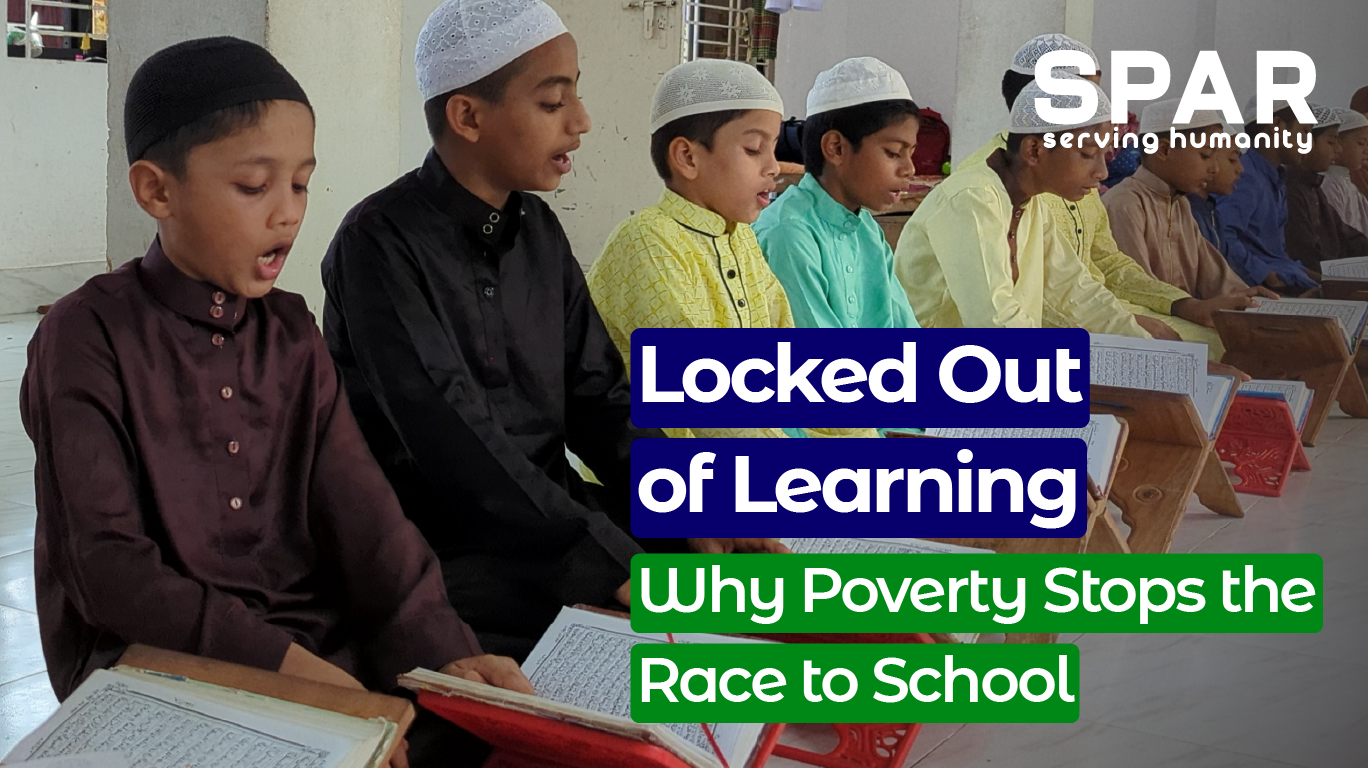
Locked Out of Learning: Why Poverty Stops the Race to School
We all like to believe that school is a fair race. We want to think that if a child works hard, they can achieve anything. But the reality is much harsher. For millions of kids today, the race starts miles behind everyone else. In many parts of the world, a child’s future depends entirely on their family’s bank account. Barriers to education in low income communities act like invisible walls, blocking children before they even reach the classroom door. It is not just about a lack of books or broken desks. It is about a complex web of poverty that forces parents to choose between a child’s lunch and their lessons. At the SPAR Project, we see these struggles every single day. This article dives into the deep-rooted issues that keep classrooms empty and explores how we can tear these walls down together.
1. The Real Cost of “Free” Schooling
Many governments claim that public education is free. Technically, they might not charge for the seat in the room. But “free” is rarely actually free. For a family living on pennies, the secondary costs are a total nightmare.
You have to buy the uniform. You have to pay for the bus or the boat to get there. You have to buy pencils, notebooks, and even light bulbs for the classroom. In many cases, schools also charge “activity fees” or “exam fees.” When a mother has to choose between buying a bag of rice or a school sweater, the rice always wins. These hidden costs are massive barriers to education in low income communities. They turn a public right into a private luxury.
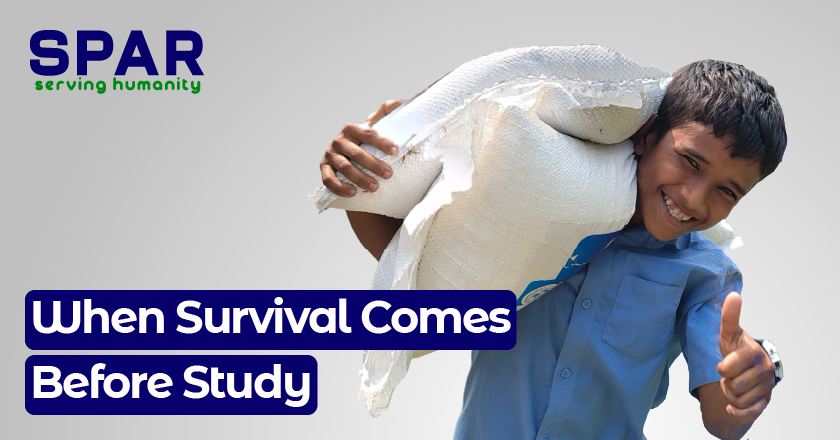
2. When Survival Comes Before Study
In the wealthiest nations, a child’s “job” is to learn. In low-income areas, a child’s job is often to help the family survive. This is known as “opportunity cost.” If a ten-year-old boy spends six hours in a classroom, he isn’t in the fields helping his father grow food. If he isn’t working, the family might not eat that night.
This pressure pulls children out of school long before they learn to read or write properly. It is a heartbreaking trade-off. The family needs the child’s labor to survive today, but by working now, the child loses the skills they need to escape poverty tomorrow. It is a loop that is incredibly hard to break.
3. The Long, Dangerous Walk to Class
Geography shouldn’t determine your intelligence, but it often determines your education. In many rural areas, the nearest school is miles away across rough terrain. There are no yellow school buses here. Children wake up before dawn to start a three-hour walk.
They cross rivers without bridges. They walk through extreme heat or heavy rain. By the time they reach the school, they are physically exhausted. If the weather is too bad or the path is too dangerous, they simply stay home. For many parents, the risk of a long, lonely walk—especially for young girls—is just too high. When the school is too far, the dream of an education simply fades away.
4. You Can’t Learn on an Empty Stomach
Hunger is one of the quietest yet most effective barriers to learning. Millions of children in poor communities suffer from chronic malnutrition. When you haven’t eaten a real meal in days, your brain stops focusing on math problems and starts focusing on survival.
Hungry children are tired. They are irritable. They cannot memorize facts or solve equations because their bodies are literally starving for fuel. Beyond immediate hunger, long-term malnutrition leads to “stunting.” This means the child’s brain and body never fully develop. These health issues stay with them for life, making it nearly impossible to keep up with well-fed peers.
5. The Gender Gap: Why Girls Stay Home
In many cultures, when a family can only afford to send one child to school, they almost always pick the son. There is an old, harmful idea that girls only need to learn how to keep a home and raise children.
Girls also face unique physical hurdles. Many schools in low-income areas lack private toilets or clean water. When a girl reaches puberty, the lack of a private bathroom often forces her to drop out entirely. Then there is the threat of early marriage. In desperate times, parents may marry off a young daughter to reduce the number of mouths they have to feed. Once a girl becomes a bride, her time in the classroom is over forever.
6. Schools Caught in the Crossfire
War doesn’t just destroy buildings; it destroys futures. In conflict zones, schools are often targets. They are bombed, burned, or used as makeshift military bases. Teachers flee to find safety, and parents keep their children hidden at home to protect them from violence.
Even when the fighting stops, the damage remains. A child who misses three years of school because of a war can rarely “catch up.” They become part of a “lost generation.” These kids grow up without the skills to rebuild their country, which leads to even more instability. Peace is the most basic requirement for any functional education system.
7. The Crisis of Missing Teachers
A classroom without a good teacher is just a room. Unfortunately, it is very hard to find qualified teachers willing to work in extreme poverty. The pay is usually very low and often arrives months late.
Teachers in these areas often have to manage sixty or eighty students in a single room. They have no textbooks, no computers, and sometimes not even a chalkboard. Many educators burn out within a year and move to the city for a better life. This leaves the most vulnerable students with the least experienced or least motivated instructors. Without steady, trained teachers, children aren’t really “learning”—they are just passing time.
8. Crumbling Buildings and No Toilets
Imagine trying to study in a room with a tin roof that leaks every time it rains. Or a room so dark you can’t see the paper in front of you because there is no electricity. This is the daily reality for millions.
Many schools in low-income communities are in total disrepair. They lack basic “WASH” (Water, Sanitation, and Hygiene) facilities. If there is no clean water to drink, children get sick. If there are no toilets, the school becomes a breeding ground for disease. A school that feels unsafe or disgusting is not a place where children can thrive. Infrastructure is not a luxury; it is a necessity for dignity and health.
9. The Modern Wall: The Digital Divide
The world is moving online, but low-income communities are being left behind. In wealthy cities, every student has a laptop and high-speed internet. In a poor rural village, a child might have never even seen a computer.
This “digital divide” means that the poorest kids are being cut off from the global economy. They don’t learn how to type, how to research, or how to use the tools that almost every modern job requires. As more learning moves to the internet, these children are being pushed even further into the shadows. Without tech access, the gap between the rich and the poor only gets wider.
10. The Weight of Constant Stress
Poverty is loud and stressful. Children in low-income areas often live in crowded, noisy homes. They might deal with family violence, housing instability, or the trauma of seeing their parents struggle every day.
This creates “toxic stress.” When a child’s brain is constantly in “survival mode,” it cannot enter “learning mode.” They struggle to pay attention. They have trouble remembering lessons. They might act out or become completely silent. These children don’t just need books; they need emotional support and a safe, calm place to exist. Without a stable environment, the best curriculum in the world won’t make a difference.
11. Language and the Wrong Lessons
In many countries, schools teach in a “prestige” language like English or French, rather than the local language the child speaks at home. This creates a massive wall. Imagine trying to learn complex science when you don’t even understand the words the teacher is using.
Furthermore, many school lessons feel totally disconnected from the child’s life. If a curriculum only talks about city life and office jobs, a child in a farming village might feel that school has nothing to offer them. When education feels irrelevant and confusing, students lose interest and drop out. We need to teach in a way that respects local culture and language.
12. How We Can Tear Down These Barriers
These problems are big, but they are not impossible to solve. At the SPAR Project, we tackle these hurdles from several angles at once.
We don’t just build schools; we build wells so kids have water. We don’t just give out books; we provide school lunches so children can focus. We work with local leaders to change minds about girls’ education. By covering the “hidden costs” like uniforms and supplies, we take the financial weight off the parents’ shoulders. Our goal is to make the path to school as smooth as possible. When you remove the obstacles, children naturally want to learn. They have the drive; they just need the chance.
Final Thoughts
The barriers to education in low income communities are a challenge to our shared humanity. Every time a child stays home because they are too hungry to walk or because they can’t afford a notebook, we all lose. We lose a future doctor, a future inventor, or a future leader. Breaking these walls takes more than just money; it takes a long-term commitment to justice. It takes a global community that decides that a child’s potential is more important than their poverty. When we open a classroom door, we aren’t just giving a child a lesson—we are giving them a way out of the cycle of poverty forever.