The Sadaqah Jariyah Hadith That Keeps Rewarding You — Even After You Die
Imagine your good deeds never stopping. Even after your last breath, your scale keeps getting heavier. That is the promise of sadaqah jariyah — ongoing charity that earns you reward without end. The sadaqah jariyah hadith from the Prophet Muhammad ﷺ gives every Muslim a way to invest in their akhirah right now. In this article, you will learn exactly what this hadith means, why scholars consider it one of the most important in Islam, and how you can act on it today. Whether you are new to this concept or want to go deeper, you will leave with full clarity and a clear next step.
What Is Sadaqah Jariyah? Understanding the Concept Clearly
Sadaqah jariyah means “ongoing charity” or “flowing charity.” The Arabic word *jariyah* comes from the root *jara*, which means to flow or run continuously. So this is not a one-time act. It is a gift that keeps giving — to others in this world and to you in the next.
Islam divides charity into two broad types. Regular sadaqah earns you reward once, at the moment of giving. Sadaqah jariyah earns you rewards again and again, for as long as that act continues to benefit people. A water well that people have been drinking from for decades. A school where students learn for generations. These are acts of sadaqah jariyah.
Scholars place sadaqah jariyah in the category of *waqf*—endowment—or any act whose benefit outlives the giver. The key condition is that the benefit must continue after your death. As long as people use what you gave, Allah records the reward in your book of deeds.
Why the Sadaqah Jariyah Hadith Is One of the Most Important in Islam
The Prophet Muhammad ﷺ said: *”When a person dies, his deeds come to an end except for three: ongoing charity (sadaqah jariyah), knowledge that people benefit from, and a righteous child who prays for him.”* — Sahih Muslim, 1631
This hadith stops most Muslims in their tracks the first time they really hear it. Death ends almost everything. Your wealth stays behind. Your status disappears. Your daily acts of worship stop. But three doors stay open—and sadaqah jariyah is the first one the Prophet ﷺ named.
That detail matters. Islamic scholars note that the Prophet ﷺ listed sadaqah jariyah before beneficial knowledge and before a righteous child. This is not accidental. It is accessible to every Muslim, rich or poor, scholar or not, parent or not. You do not need children. You do not need years of study. You just need to give in a way that keeps helping people. That single act can carry rewards to you until the Day of Judgment.
This is why millions of Muslims around the world search for ways to give sadaqah jariyah. It is not just charity. It is the smartest investment a believer can make — one where the return never stops.
What Makes a Sadaqah Jariyah Different From Regular Charity
Regular sadaqah ends when the benefit ends. You feed someone today. They eat. The reward is recorded. That chapter closes. Sadaqah jariyah works differently. The benefit continues flowing to people — and so does your reward.
Think of it like a river versus a cup of water. Both are real. Both matter. But only one keeps moving after you walk away.
The keyword in Arabic is *jariyah* — from the root *jara*, meaning to flow or run. Scholars explain this as any act whose benefit outlasts the giver’s effort. The Prophet ﷺ used this word deliberately. He was pointing Muslims toward a category of giving that has no ceiling on reward.
The Most Powerful Sadaqah Jariyah Hadith You Need to Know
The most cited hadith on this topic comes from Abu Hurairah (RA). The Prophet ﷺ said:
*”When a person dies, his deeds come to an end except for three: ongoing charity, knowledge others benefit from, and a righteous child who prays for him.”*
— Sahih Muslim, 1631
But there is a second hadith that adds an important detail. The Prophet ﷺ said,
*”The best of what a man leaves behind after he dies are three: a righteous child who makes du’a for him, ongoing charity whose reward continues to reach him, and knowledge that others benefit from after him.”*
— Ibn Majah, 237 (Sahih)
Both narrations confirm the same truth. Death stops your ability to act. Sadaqah jariyah removes that limit. It keeps acting for you. Every person who drinks clean water from a well you funded, every child who learns to read in a school you helped build—their benefit flows back to you as a reward.
What Counts as Sadaqah Jariyah? (According to Islamic Scholars)
Scholars across the major madhabs have discussed what qualifies. The agreement is broad. Any gift that produces a lasting, recurring benefit for others falls under sadaqah jariyah. Here are the types they most often mention.
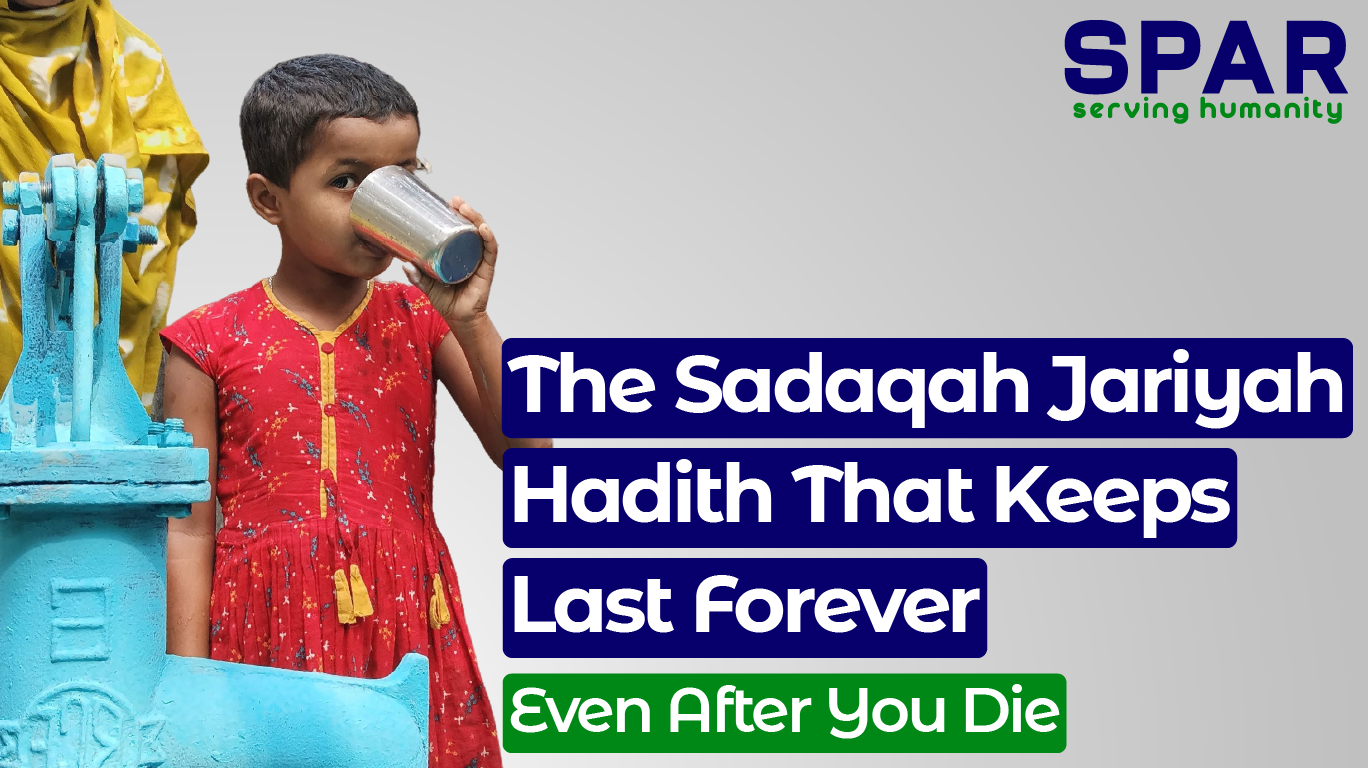
A water well or clean water source. This is the single most recommended form of sadaqah jariyah in classical and modern scholarship. The Prophet ﷺ himself pointed to it directly when Sa’d ibn Ubadah (RA) asked what he should give on behalf of his deceased mother. The Prophet ﷺ said: *”Water.”* — Abu Dawud, 1681. Every sip taken is a new act of benefit. Every new act of benefit is a new reward recorded for you.
Planting trees or cultivating food. The Prophet ﷺ said: *”There is no Muslim who plants a tree or sows seeds, and then a human, bird, or animal eats from it, except that it counts as charity for him.”* — Sahih al-Bukhari, 2320. The tree does not ask who planted it. The reward does not stop.
Building a masjid, school, or place of benefit. Supporting education for orphans and underprivileged children — such as through SPAR Project’s education programs — connects directly to this category. Every lesson learned, every skill gained, and every du’a made by a child you helped educate carries a reward back to you.
Leaving behind beneficial knowledge. Writing, teaching, funding scholarship — anything that spreads correct understanding of the deen qualifies. The chain of reward can stretch across generations.
Why a Water Well Is the Most Recommended Form of Sadaqah Jariyah
Clean water sits at the foundation of every human need. You cannot pray in a state of purity without water. You cannot cook food, raise healthy children, or prevent disease without it. When you give water, you are not giving one thing. You are giving the foundation for everything else.
This is why the companions specifically asked the Prophet ﷺ about water when they wanted to give on behalf of loved ones who had passed. And this is why Islamic scholars, from the classical period to today, consistently rank a water well at the top of the sadaqah jariyah list.
SPAR Project has installed over 250 clean water wells across Bangladesh. Communities that previously walked hours for unsafe water now have clean water within reach. Children who used to get sick from contaminated sources are growing up healthier
How to Give Sadaqah Jariyah the Right Way
- Make a sincere intention.
Before you give a single penny, set your intention for Allah alone. The Prophet ﷺ said: “Actions are by intentions.” (Sahih al-Bukhari, 1) Your niyyah is what transforms a donation into an act of worship.
- Choose a cause with lasting impact.
One-time charity feeds for a day. Sadaqah jariyah feeds for decades. Pick something that continues working after your hand pulls back — a well, a school, a Quran program, an orphan sponsorship.
- Give through a trustworthy, registered organisation.
Your money is only as good as the hands it passes through. Check that the charity is legally registered, has a clear track record, and publishes what it actually does on the ground.
- Give in the name of someone who has passed, if you wish.
The scholars agree that this is valid, and the deceased receives the reward. Make the intention clear before giving. You can also give on behalf of the living as a gift of remembrance.
- Give again, even if it is small.
The Prophet ﷺ said: “The most beloved deeds to Allah are the most consistent ones, even if they are small.” (Sahih al-Bukhari, 6464) Set up a monthly gift. Small amounts that flow without stopping build bigger rewards than large one-off donations.
Mistakes to Avoid
Delaying until you have “enough” to give. Shaytan uses waiting as a tool — small sadaqah given today is better than large sadaqah planned for tomorrow.
Giving without checking the charity’s credibility. Not every fundraiser is honest; misused donations do not earn the reward of sadaqah jariyah, so verify before you trust.
Thinking only the wealthy can give sadaqah jariyah. A well can be shared between donors, meaning even a small contribution builds something permanent and earns a proportionate reward.
Forgetting to make the intention before giving. The physical act without a conscious intention is just a transaction, not an act of worship — pause, name your intention, then give.
Giving only at Ramadan and stopping after Eid. Sadaqah jariyah earns reward every day the benefit continues, so consistent giving across the full year multiplies what reaches you in your grave.
Why Give Through SPAR Project
SPAR Project is a registered Islamic non-profit based in Bangladesh, operating since 2009 under NGO Affairs Bureau Registration No. 2424. For over fifteen years, the organisation has channeled donor money directly into the communities that need it most — no wasted overhead, no vague promises.
Every donation you make goes toward real, verifiable work:
Clean water wells for villages with no safe water source, giving families pure water for drinking, cooking, and wudu every single day.
Orphan sponsorship covering food, school fees, clothing, and healthcare for children who have lost their parents and have no one else to turn to.
Education programs for children whose families simply cannot pay school fees keep them in classrooms instead of sending them to work.
Healthcare and emergency relief for the most vulnerable families, including flood-affected communities across Bangladesh, who lose everything in hours.
SPAR Project publishes its work openly. Donors receive updates on the wells they fund and the orphans they sponsor. You will know where your money went. You will see the face of the child your sadaqah is feeding. That transparency is not just good practice — it is an amanah, a trust, that SPAR takes seriously.
Final Thoughts
Every soul that passes through this world will stand before Allah and account for what it sent ahead. The sadaqah jariyah hadith is not a piece of religious trivia. It is a map. It shows you exactly how to keep earning after the door of this life closes behind you.
A child in rural Bangladesh drinking clean water from a well you funded does not know your name. But Allah does. Every sip that child takes, every prayer made in a state of purity, every illness prevented — the record of that reward is kept by the One who never forgets and never loses a single good deed.
Do not let this moment pass without acting on what you have just read. You came here to understand