Mosque Donation in Islam: The Reward, the Rules, and Whether Zakat Counts
Mosque donation in Islam is any voluntary or obligatory financial gift given through or for a mosque — to fund worship, community services, or charitable aid. It covers acts like Zakat, Sadaqah, and Waqf. These aren’t just financial acts. They’re worship.
Why Mosque Donation in Islam Matters Right Now
About 1.8 billion Muslims worldwide practice giving as a core part of their faith, according to Pew Research Center. That giving — routed through mosques and Islamic charities — funds schools, clinics, and food programs. It’s one of the largest streams of private aid on earth.
Mosque Donation in Islam: What Most People Don’t Know
Many people treat mosque donation as a single act. But Islamic scholars recognize distinct categories — each with different rules, recipients, and spiritual weight. The UK National Zakat Foundation notes that Zakat alone requires a minimum threshold (nisab) before it becomes due. Sadaqah and Waqf carry their own conditions too.
The Four Main Types of Mosque Donation in Islam
Islamic giving isn’t one thing. It breaks into at least four distinct acts — Zakat, Sadaqah, Waqf, and Qard al-Hasan — each with its own rules and purpose. Scholars treat them as separate pillars of the same structure.
Zakat: The Obligatory Share
Zakat is a fixed duty. Muslims who hold wealth above the nisab threshold for one lunar year must give 2.5% of that wealth. The National Zakat Foundation estimates global Zakat potential at $300 billion to $1 trillion USD annually — most of it never collected.
Sadaqah: The Open Gift
Sadaqah is voluntary. There’s no minimum and no fixed time. The Prophet Muhammad ﷺ said: “Every act of goodness is sadaqah” (Sahih al-Bukhari, Book 8, Hadith 424). It can be money, food, time, or even a kind word.
Waqf: The Permanent Endowment
Waqf locks an asset — land, a building, cash — into permanent charitable use. The asset itself can’t be sold or spent. Only the income from it goes to the cause. The World Bank’s Islamic Finance program calls Waqf one of the oldest and most stable forms of community finance in the world.
Qard al-Hasan: The Interest-Free Loan
Qard al-Hasan is a loan given without any return expected. It’s not charity — but it’s rewarded as charity. It helps a neighbor through a hard season without creating debt traps.
Common Misconceptions About Mosque Donation in Islam
Most people assume mosque donation means dropping cash into a collection box on Friday. But that’s only one small part. Many acts — including Waqf, food aid, and interest-free loans — count as mosque-based Islamic giving under classical scholarship.
“Zakat Can Go to Anyone”
It can’t. The Quran lists exactly eight eligible categories for Zakat in Surah At-Tawbah (9:60): the poor, the needy, Zakat collectors, those whose hearts are inclined, slaves seeking freedom, debtors, those in the way of Allah, and stranded travelers. Non-eligible recipients — including mosques themselves in some scholarly opinions — don’t qualify for Zakat funds.
“Small Gifts Don’t Count”
They do. Ibn Abbas reported that the Prophet ﷺ said: “Protect yourself from hell-fire even by giving half a date in charity” (Sahih al-Bukhari, Book 24, Hadith 498). No gift is too small to carry spiritual weight.
“Mosque Donation Only Helps Local Communities”
Not always. Many mosques channel funds through international Islamic charities to reach disaster zones, refugee camps, and rural areas across Asia and Africa. Mosque donation in Islam can cross borders.
Who Benefits Most From Mosque Donation in Islam?
The people who benefit most are those in acute need with no formal safety net — orphans, widows, rural farmers, and displaced families. In Bangladesh alone, UNICEF estimates that over 11 million people need humanitarian help each year.
Rural Families in Flood-Prone Regions
Bangladesh loses up to 20% of its land to seasonal flooding, according to World Bank data. Families in chars — river islands — lose crops, homes, and livestock in a single week. Mosque-based giving reaches places that formal aid systems miss.
Orphans and Child-Headed Households
The Prophet ﷺ said: “I and the caretaker of an orphan will be in paradise like this” — and he joined his index and middle fingers (Sahih al-Bukhari, Book 78, Hadith 24). Islamic giving has always prioritized children without parents. In Bangladesh, an estimated 4.8 million children are classified as orphans
What Mosque Donation in Islam Means for the People Who Need It Most
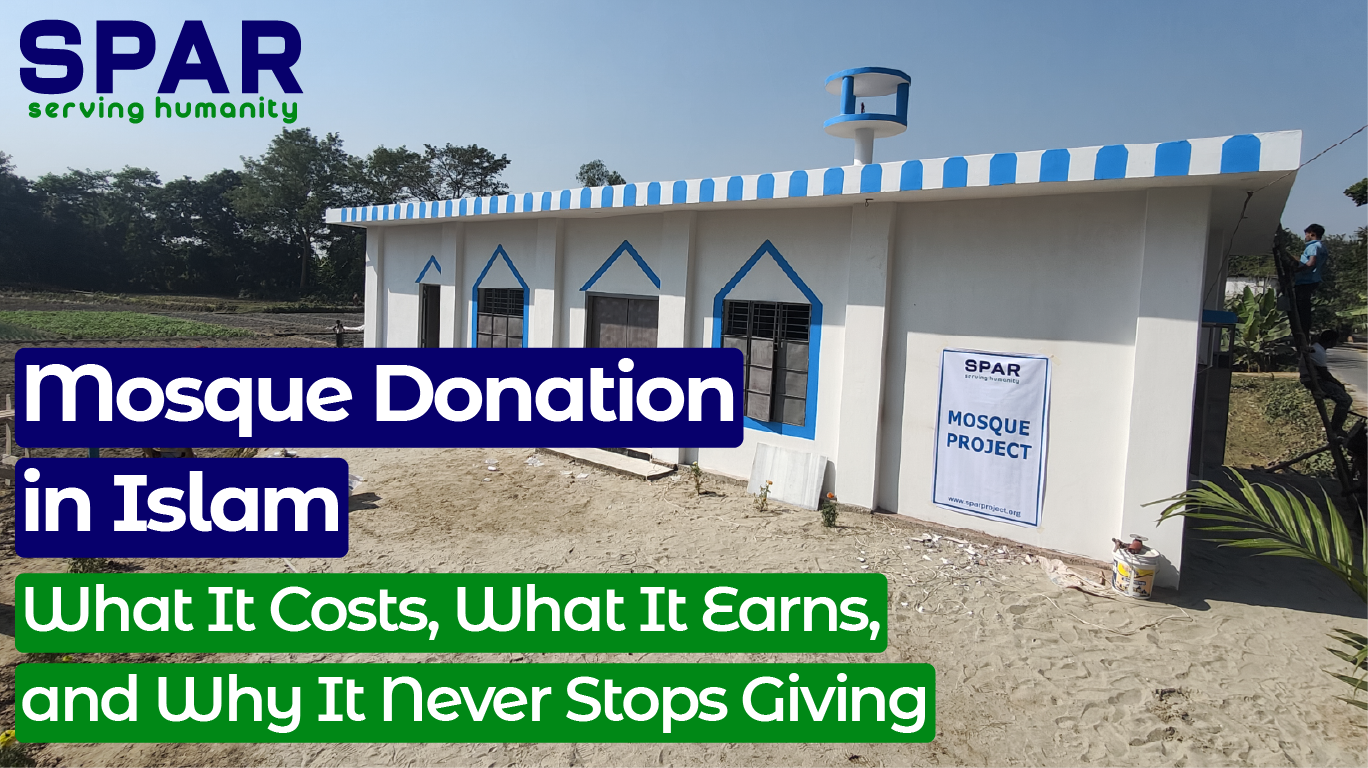
Mosque donation in Islam isn’t just a transaction. It’s a system — one that has fed, clothed, and sheltered communities for over 1,400 years. SPAR’s work in Bangladesh shows what that system looks like when it runs well.
How Givers Can Make the Most of Mosque Donation in Islam
Start with verified organisations. Look for ones with field presence, named programs, and published reports. A $30 gift through a trusted channel can fund clean water for one family for a year.
What Changes When Communities Give Consistently
One-off gifts help. But consistent giving builds tube wells, funds teachers, and keeps clinics open. The UNDP finds that sustained community investment cuts extreme poverty faster than emergency aid alone.
Behind every working well in a char village, there’s a long chain of quiet decisions — people who chose to stay involved after the moment passed. At SPAR, our team works in flood-prone districts in Bangladesh because that chain hasn’t broken yet.