Masjid Donation: What It Is, What It Isn’t, and Why Bangladesh Needs Yours Now
A masjid donation is money or resources given to build, maintain, or run a mosque — one of Islam’s oldest acts of continuous charity. Unlike zakat, which follows strict rules, masjid donations are voluntary and open to anyone who wants to give. Muslims have funded mosques this way since the Prophet’s ﷺ time, starting with Masjid Quba in 622 CE. The reward doesn’t stop when you give — it continues as long as the masjid stands and people pray inside it.
Why Masjid Donation Matters Right Now
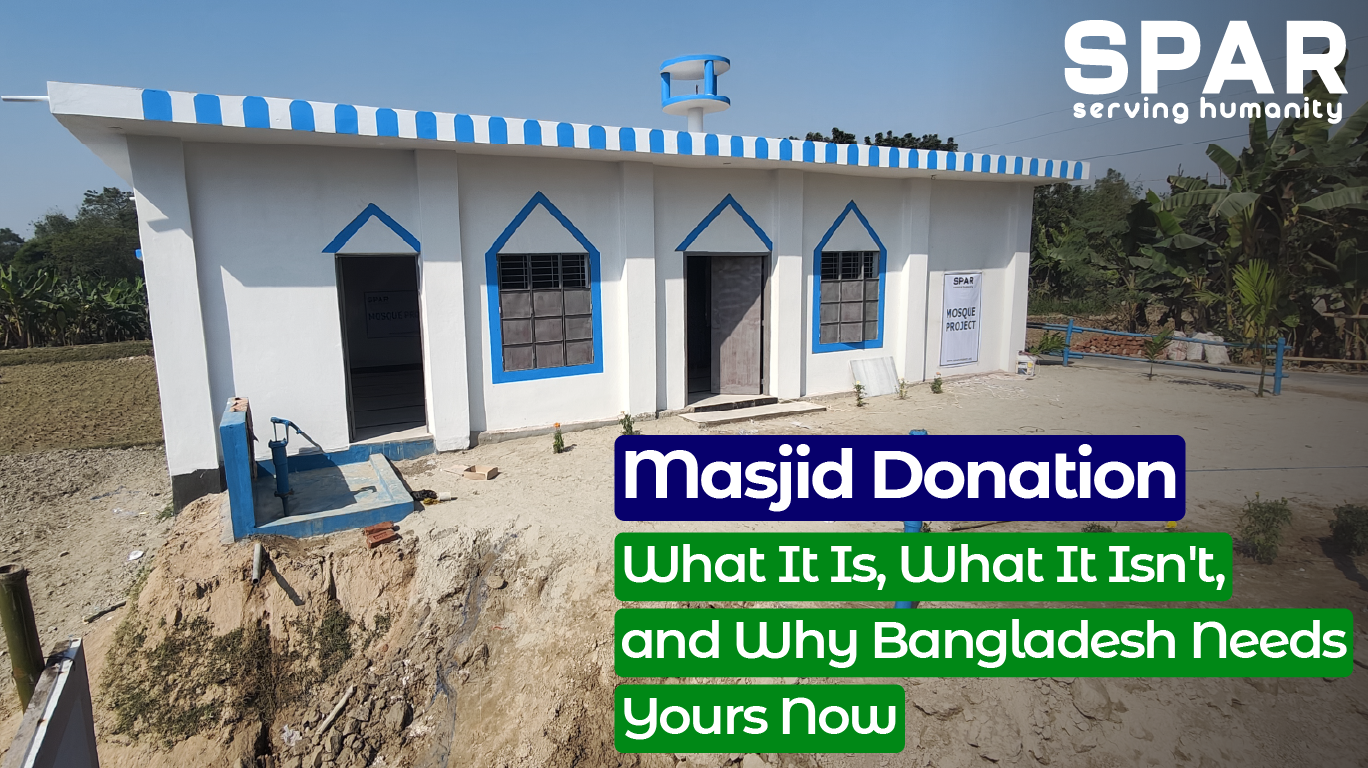
Mosques do more than hold prayers. In Bangladesh alone, many rural masjids double as flood shelters, madrasas, and community halls – especially in flood-prone districts like Sylhet and Sunamganj. According to the UN Office for the Coordination of Humanitarian Affairs, over 7 million people in Bangladesh face displacement each monsoon season. A masjid with a solid roof and clean water access becomes a lifeline. That’s what a masjid donation funds in practice – not just worship, but survival. SPAR’s work in these regions shows exactly how far structured mosque support can go when it’s built on real community need.
Masjid Donation by the Numbers
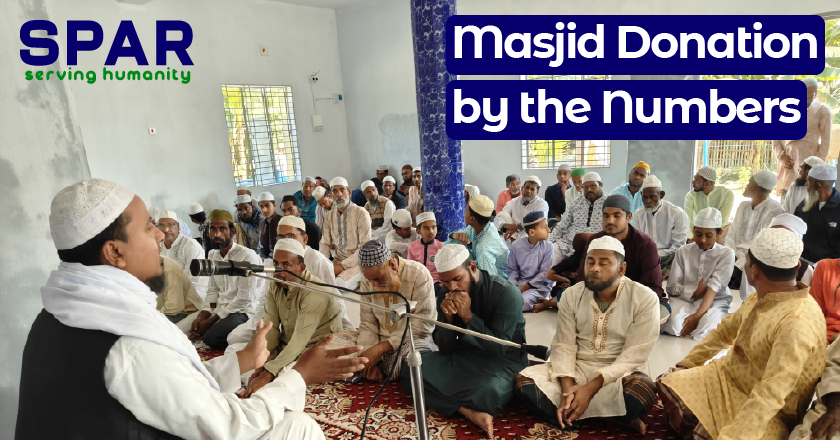
The scale of mosque need across the Muslim world is hard to miss. The World Muslim League estimates there are over 3.6 million mosques worldwide — and a large share of them, particularly in South Asia and sub-Saharan Africa, don’t have reliable funding. In Bangladesh, where about 91% of the population is Muslim (Bangladesh Bureau of Statistics, 2022), thousands of masjids in rural upazilas run on irregular community collections. A single masjid serving 400 families can cost as little as $200 USD a year to maintain. That’s the kind of specific, trackable impact that makes masjid donation different from general charity — you can see exactly where the money lands.
What Types of Masjid Donation Actually Exist?
Most people think of masjid donation as one thing — a collection plate passed around on Friday. But there are several distinct forms it takes. Capital giving covers construction or major repairs: a new roof, a well, a boundary wall. Operational giving funds the imam’s wage, utilities, and cleaning. Waqf endowments create a permanent income stream — often land or property held in trust. And then there’s sadaqah jariyah: a specific gift tied to a named need, like a water pump or a Quran library. Each type carries different legal and spiritual weight. Knowing the difference helps donors choose where they want their money to sit.
Capital Giving vs. Operational Support
Capital gifts are one-time. A $500 capital gift might fund a metal roof that lasts 20 years. Operational gifts are recurring. They cover the costs that keep a masjid open day to day — water, electricity, basic repairs, and sometimes a part-time caretaker. In rural Bangladesh, many masjids get capital gifts during Ramadan but run dry the rest of the year. That funding gap is where operational masjid donation matters most. A $30-a-month commitment does more for daily continuity than a single large gift every few years.
Waqf and Sadaqah Jariyah: The Long-Term Forms
A waqf is an Islamic endowment — an asset set aside permanently for community benefit. Ibn Qudamah, the classical scholar, described waqf as “locking the asset and freeing its benefit.” It’s one of the oldest forms of structured Muslim giving. Sadaqah jariyah is slightly different: a gift whose reward continues after the donor dies. The Prophet Muhammad ﷺ named it among three deeds that outlast a person’s life (Sahih Muslim, Book 13, Hadith 1631). A water point inside a masjid compound qualifies. So does a Quran left for worshippers to read. Both forms of masjid donation build something that outlasts the moment of giving.
Who Needs Masjid Support the Most?
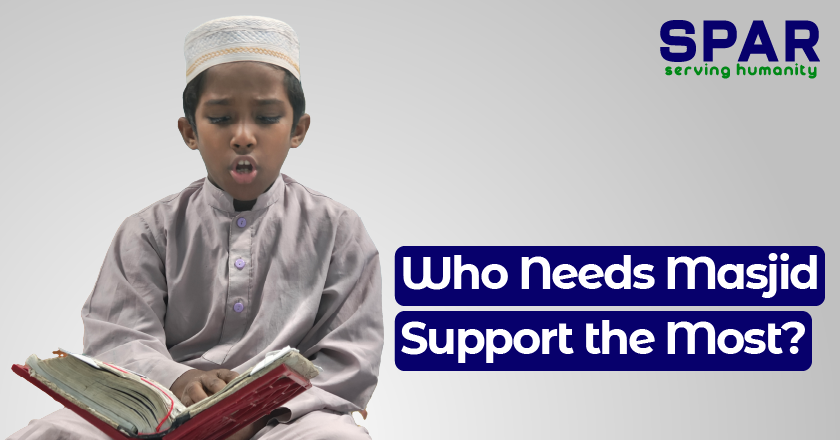
Rural Muslim communities in low-income countries feel the gap first. In Bangladesh, about 68% of the population still lives outside major cities, according to the World Bank. Many of those communities rely on a single masjid that serves several thousand people — with no paid staff and no maintenance fund. Children use the masjid for Quran lessons. Women use it as a meeting point. Elders use it for daily prayer. When the structure fails — a cracked wall, a flooded floor, a broken wudu tap — the whole community loses its centre. The need isn’t evenly spread, but it’s consistent: rural areas, flood-prone land, low-income upazilas.
Real Impact: What We Saw in Jamalpur
Our team visited Jamalpur District in March 2025. We met a man named Rafiq — a retired schoolteacher who had been leading Fajr prayer in a half-built masjid for six years. The roof covered only the front two rows. In the monsoon, worshippers prayed under umbrellas. Rafiq told us the community had raised $80 toward a full roof but needed $420 more. That gap had stayed unfilled for three years. Small, targeted masjid donation — structured and tracked — is exactly what closes gaps like Rafiq’s. See how SPAR’s field teams work on projects like this →
Common Mistakes in Masjid Giving
Many donors give once and assume the job is done. That’s the most common error. A masjid roof costs $400 to $600 to complete — but without ongoing maintenance, it fails within a decade. According to UNICEF, water and sanitation infrastructure in rural South Asia loses 40% of its function within five years without follow-up care. The same logic applies to masjid buildings. One-time gifts fix the visible problem. Sustained, smaller gifts — even $20 a year — keep the fix working. Masjid donation works best when it’s treated as a commitment, not a transaction.
What Masjid Donation Looks Like in Practice
Masjid donation is not one action. It’s a pattern. According to UNICEF, rural infrastructure in South Asia loses nearly half its function within five years without follow-up care. The same applies to masjid buildings. A $400 roof needs upkeep. A $200 wudu station needs a clean water source behind it. Donors who stay involved — even at $20 a year — create conditions that last. Zakat, sadaqah jariyah, and structured community waqf all point toward the same truth: the gift that keeps working is the one that was never treated as finished.
Behind every repaired masjid is a quiet chain of people who stayed engaged long after the easy moment passed. In Jamalpur, Rafiq still leads Fajr. The roof gap closed — not because of one large gift, but because someone decided the $420 was worth tracking down. At SPAR, our field teams work the same way: steady, close, and specific. That’s the work we keep doing in Bangladesh.