Sadaqah Charity: What It Is, Who It Helps, and Why It Counts
Sadaqah charity is any act of voluntary giving done purely for the sake of Allah — money, food, time, or even a kind word. It differs from Zakat, which is obligatory. Sadaqah has no fixed amount and no minimum threshold. Any Muslim — or anyone moved to give — can practice it. Right now, millions of families across the world depend on Sadaqah-funded aid to meet basic needs.
Why Sadaqah Charity Matters Right Now
Poverty doesn’t wait. According to the United Nations, about 733 million people went hungry in 2024 — and that number keeps rising. Sadaqah charity fills the gaps that governments and large institutions miss. It reaches the family that falls just outside a program’s criteria. It funds the meal, the well, the school uniform. In Bangladesh alone, seasonal flooding pushes hundreds of thousands into sudden need every year. That need is real, it’s recurring, and it’s right now. Sadaqah doesn’t require a fatwa or a formal process. It asks only for intention — and action. That speed and simplicity make it one of the most direct tools for human relief that exists.
Sadaqah Charity: What Most People Don’t Know
Sadaqah isn’t just cash. The Prophet Muhammad ﷺ said that even a smile is Sadaqah — recorded in Sahih al-Bukhari. But the scale of what sustained Sadaqah can do often surprises donors. A single $30 contribution can provide clean drinking water for a family in rural Bangladesh for a full year. At SPAR, our teams work in flood-prone districts like Sylhet and Jamalpur — places where $50 can feed a household through a lean month. Scholars like Ibn al-Qayyim wrote that Sadaqah doesn’t just help the receiver. It purifies the giver’s wealth and guards against harm. That dual reward — spiritual and material — is why Sadaqah sits at the heart of Islamic social welfare. Most donors don’t realize how far a small, consistent gift actually travels.
Does Sadaqah Charity Have Different Forms?
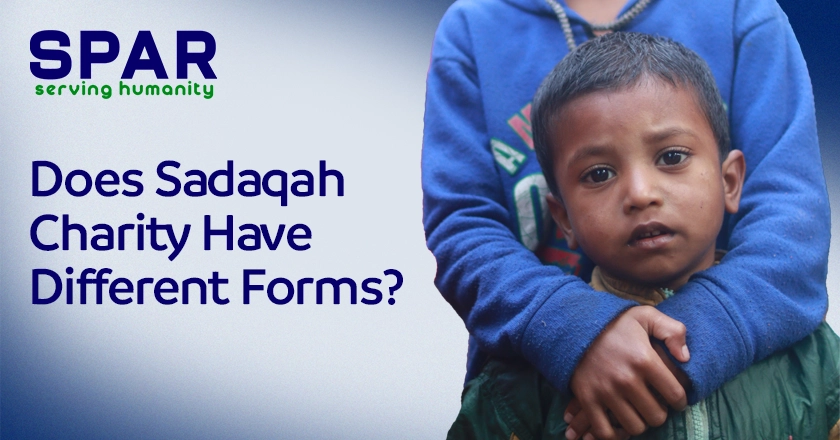
Sadaqah covers far more than cash gifts. Scholars classify it across three broad types: voluntary financial giving, non-financial acts of service, and ongoing endowments — known as Sadaqah Jariyah. Each type carries full reward in Islamic teaching. Ibn al-Qayyim noted that physical acts done with sincere intent — clearing a path, carrying someone’s load — count as Sadaqah just as money does. For donors thinking about impact, this matters. A $30 gift to fund clean water is Sadaqah. So is the time a volunteer spends distributing food in Jamalpur after a flood. The form changes. The intention doesn’t.
Sadaqah Jariyah: The Giving That Keeps Going
Sadaqah Jariyah — ongoing charity — is the form most scholars consider the highest in long-term reward. The Prophet Muhammad ﷺ described it as one of three deeds that continue to benefit a person after death, recorded in Sahih Muslim. A water well, a school, a planted tree — these keep giving long after the gift is made. In flood-prone districts like Kurigram, a single hand-pump well serves a family for years. The gift is made once. The benefit runs through every dry season that follows.
Non-Financial Sadaqah: What Counts
Not every act of Sadaqah needs money behind it. Teaching a child to read is Sadaqah. Removing a harmful object from a road is Sadaqah. Guiding someone who is lost — Sadaqah. This broad scope is deliberate. Islamic teaching has always made charity accessible to every Muslim, regardless of wealth. For communities in rural Bangladesh, where cash is scarce after floods, this understanding matters. Service, skill, and time are all valid currencies in the economy of giving.
Who Needs Sadaqah Charity Most Right Now?
The people most affected by poverty in Bangladesh are children under five, women in flood-displaced households, and day laborers who lose income when seasonal floods hit. According to UNICEF, about 19 million people in Bangladesh live in areas at high risk from flooding each year. Children in these zones often miss months of school. Families sell assets — livestock, tools — just to eat. By the time water recedes, they’ve lost the means to recover on their own. Sadaqah charity reaches these households at exactly the moment formal aid systems move too slowly.
What Real Impact Looks Like on the Ground
Our team visited Sunamganj District in March 2025. We met Fatema — a mother of four whose home had flooded twice in eight months. Her family had no clean water source left. A $30 water filter, funded through Sadaqah contributions, gave them safe drinking water within a day of delivery. The World Health Organization estimates that 1.4 million people die each year from diseases linked to unsafe water. Fatema’s family was close to that statistic. They aren’t now. That shift — from risk to safety — is what Sadaqah charity produces when it’s organized, targeted, and consistent.
Why Small, Consistent Sadaqah Outperforms One-Time Gifts
One large gift grabs attention. But it’s the small, repeated gifts that build lasting change. A $10 monthly contribution over a year funds more continuous relief than a single $120 gift given once — because recurring funds let field teams plan, restock supplies, and stay present between crises. Bangladesh doesn’t face one flood a decade. It faces seasonal disruption every year, often twice. Communities here are slowly turning this around — but the change takes years, not months, and depends on quiet, consistent support from people far from the problem.
What Sadaqah Charity Means for the People Who Need It Most
Sadaqah charity works best when it’s steady and close to the ground. UNICEF data shows over 19 million people in Bangladesh still lack access to safe water. That’s not a distant statistic — it’s the daily reality for families in Sylhet, Sunamganj, and Cox’s Bazar. Sadaqah jariyah builds the kind of infrastructure that outlasts one crisis. Voluntary charity, when it reaches organized field teams, funds water filters, emergency food, and shelter repairs. The gap between hardship and recovery is often smaller than we think.
Does the Scale of Need Change How Sadaqah Should Be Given?
Small, targeted giving matters more than most people realize. One family’s clean water access can cost as little as $30. Across a flood-prone district, $300 can protect ten households for a full year. The Islamic concept of sadaqah covers any voluntary act of goodness — and organized charities turn that goodness into planned relief. Consistent giving lets field teams work ahead of the next crisis, not just react to it.
What Makes Sadaqah Charity Different From a One-Off Gift?
A one-off gift responds to one moment. Sadaqah charity, given with intention and consistency, responds to a pattern. Flood seasons in Bangladesh follow a yearly cycle. So do the families who lose everything. Sadaqah jariyah — the kind that funds a well or a water point — keeps giving after the initial gift stops. That’s the difference: a single act of charity feeds one day. A structured act of sadaqah funds years.
Behind every clean water point in rural Bangladesh is a long chain of quiet decisions. Someone chose to stay involved. Someone chose to give again in the month when there were no news headlines. At SPAR, that’s the work — steady, close to need, and built on the kind of voluntary charity Islam has always called its followers toward. See how this work continues →