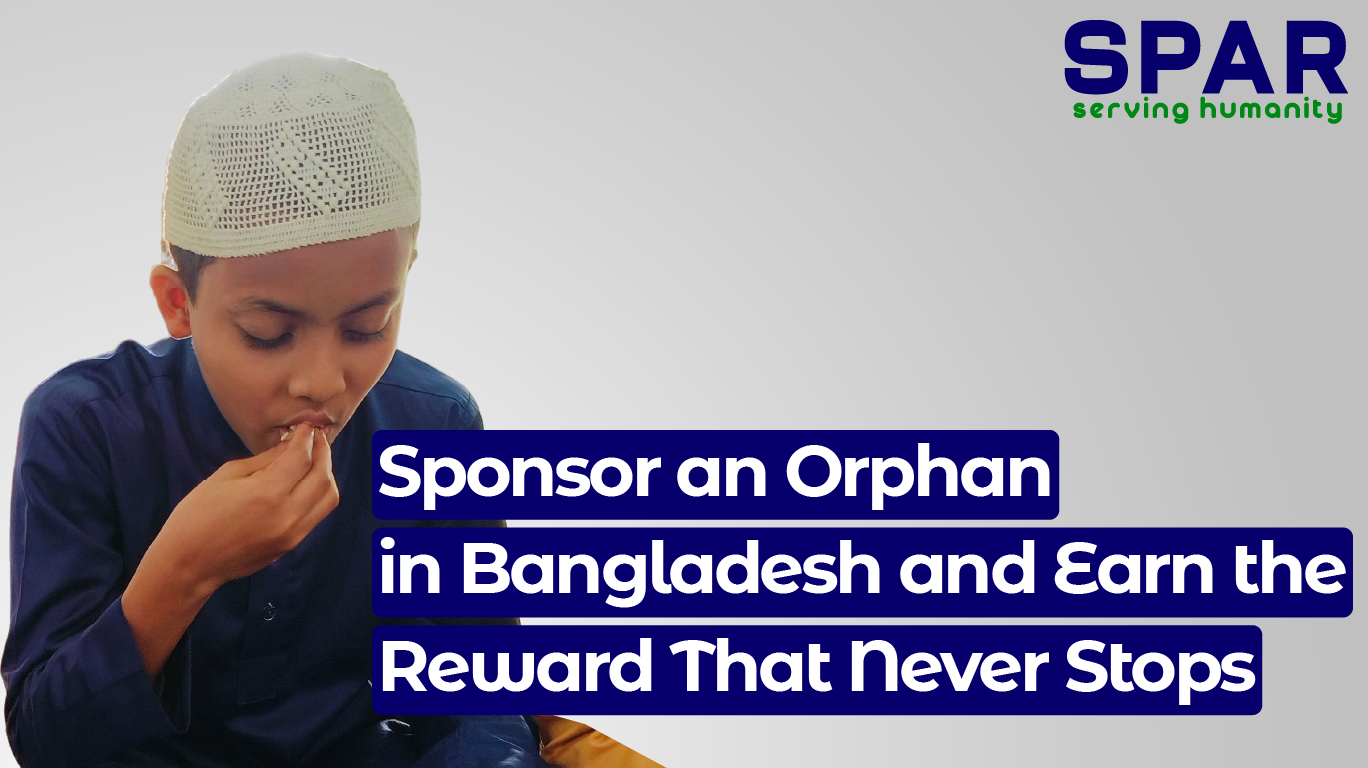
Sponsor an Orphan in Bangladesh and Earn the Reward That Never Stops
Sponsoring an orphan in Bangladesh means providing a vulnerable child with regular financial support — covering food, education, healthcare, and emotional care. Bangladesh is home to an estimated 4.8 million orphans, many of whom live without safe shelter or any adult protection. Through a monthly commitment as small as £25–£30, donors around the world can change that reality. This article explains exactly what orphan sponsorship in Bangladesh involves, what your money covers, how Islamic giving principles connect to this act of charity, and how SPAR—the Society for Participatory Action and Reflection—delivers this support directly to children in need. By the end, you will know exactly how to sponsor an orphan in Bangladesh and why doing so is one of the highest-impact donations you can make.
What Is Orphan Sponsorship in Bangladesh?
Orphan sponsorship in Bangladesh is a giving model where a donor provides regular financial support to a specific child who has lost one or both parents. It covers essential needs including food, education, and healthcare. Sponsorship runs monthly, creating stability that one-off donations cannot.
Bangladesh faces one of the highest orphan populations in South Asia. UNICEF estimates that millions of children across the country grow up without consistent parental care — leaving them exposed to poverty, child labour, early marriage, and trafficking.
Sponsorship is different from general charity. It creates a direct, ongoing relationship between a donor and a child. That consistency matters enormously. Children who receive sustained support are more likely to complete primary school and less likely to fall into exploitative work, according to Save the Children’s Bangladesh research.
At SPAR, orphan sponsorship means a named child receives guaranteed monthly support managed by a team with direct field presence in Bangladesh. You give. A real child benefits. The link is traceable.
Why Sponsoring an Orphan in Bangladesh Matters
Bangladesh has over 4.8 million orphaned children. Many have no access to schooling, consistent meals, or medical care. Without support, these children face a future defined by deprivation — not potential.
The scale of need makes Bangladesh one of the most urgent destinations for orphan sponsorship globally. The World Bank’s Bangladesh poverty data shows that despite national economic growth, the most vulnerable children — those without family income — remain largely left behind by structural progress.
For Muslim donors, the urgency runs even deeper. The Prophet Muhammad ﷺ said: *”I and the one who cares for an orphan will be in Paradise like this”* — and he held up his index and middle fingers together. This hadith appears in Sahih al-Bukhari (Book 73, Hadith 34). It is one of the most cited hadith on charity in the Islamic tradition, and scholars including Imam An-Nawawi have written extensively on its meaning.
Sponsoring an orphan in Bangladesh is not a passive act of giving. It is a sustained commitment that replaces — partially, but meaningfully — what a parent provides. Food every day. School fees paid on time. A trusted adult checking in. That consistency shapes a child’s entire trajectory.
Give monthly through SPAR — sponsor an orphan in Bangladesh today →
What Does Orphan Sponsorship in Bangladesh Actually Cover?
Orphan sponsorship covers the essential costs a child cannot meet alone: food, school fees, clothing, medical care, and sometimes housing support. A monthly contribution — typically between $30 and $50 — funds these basics consistently. That consistency is what separates sponsorship from a one-time donation.
Without a sponsor, many Bangladeshi orphans drop out of school by age ten. They enter informal labor to survive. UNICEF’s child labor data for South Asia shows that children from the poorest households are five times more likely to work instead of study. Sponsorship breaks that cycle directly.
At SPAR, sponsorship packages include regular welfare checks, educational support, and nutritional assistance. Every sponsored child receives documented updates so donors can see exactly where their money goes.
How Does Sponsoring an Orphan Differ From a One-Time Donation?
A one-time donation helps in the moment. Sponsorship builds a child’s future month by month. The difference is continuity — and continuity is what changes outcomes in child development, not a single cash transfer.
Think of it this way. A one-time gift might pay for a school uniform. Monthly sponsorship pays for the uniform, the books, the exam fees, and the meal that gets a child to school alert enough to learn. Research from Save the Children’s education reports consistently shows that sustained investment — not periodic aid — determines whether a child completes primary school.
For donors motivated by Islamic giving, this distinction matters spiritually too. Scholars including Sheikh Ibn Uthaymeen noted that ongoing acts of charity carry greater weight than isolated ones, because they reflect a genuine relationship of care — not a transaction.
The Islamic Case for Long-Term Orphan Care
Islam does not treat orphan care as optional generosity. It is a recurring command. The Quran mentions orphans in over twenty verses, always pairing their mention with direct obligation. Surah Al-Baqarah (2:220) calls for dealing with orphans “in a way that is best for them” — a standard that implies sustained attention, not a single act.
The Prophet Muhammad ﷺ himself was an orphan. He lost his father before birth and his mother at age six. Islamic scholars have long argued that this personal experience shaped his repeated emphasis on orphan care — and that Muslims who sponsor orphans follow a prophetic model, not merely a charitable one.
Surah Ad-Duha (93:9) is equally direct: *”As for the orphan, do not oppress him.”* Imam An-Nawawi’s commentary on this verse stresses that neglect constitutes a form of harm. Sponsoring an orphan in Bangladesh is, in this framework, a fulfillment of Quranic duty — not just a donation.
Fulfill your obligation — sponsor a child through SPAR today →
Can Orphan Sponsorship Count as Sadaqah Jariyah?
Yes. Orphan sponsorship qualifies as Sadaqah Jariyah — ongoing charity — when it funds something that continues to benefit the child beyond the donation itself. Education is the clearest example. A school year paid for creates skills and knowledge that stay with a child for life.
The Prophet Muhammad ﷺ identified three forms of charity that continue after death: a righteous child who prays for you, knowledge that benefits others, and ongoing charity. This appears in Sahih Muslim (Book 13, Hadith 1631). Sponsoring a child’s education directly maps onto two of these three categories simultaneously.
Many donors at SPAR specifically choose monthly education-linked sponsorships for this reason. They want their giving to compound — spiritually and practically — long after the payment clears.
Who Qualifies as an Orphan Under Islamic and Humanitarian Definitions?
Under Islamic law, an orphan is a child who has lost their father before reaching puberty. This is the classical definition used by scholars including Ibn Baz. Many humanitarian organizations use a broader definition: a child who has lost one or both parents, or who lives without parental care due to abandonment or disability.
In Bangladesh, both definitions apply at scale. Many children in SPAR’s programs have lost their
How to Sponsor an Orphan in Bangladesh the Right Way
Sponsoring an orphan in Bangladesh takes five minutes to set up but creates years of impact. Choose a reputable organization, confirm the child’s verified need, select a giving amount, set up recurring payments, and stay connected through updates. Here is exactly how to do it.
- Verify the organization’s registration. Confirm the charity holds valid NGO Affairs Bureau registration in Bangladesh. This is the government body that regulates foreign-funded nonprofits, and registration is a baseline accountability signal.
- Request a child profile before committing. Legitimate programs provide basic details: the child’s age, location, and specific needs. You do not need a full name or photo to confirm the child exists. A district reference and a program code are enough.
- Choose your sponsorship type. Education-linked sponsorships cover school fees, books, and uniforms. Nutrition-focused sponsorships address food security and health checks. Some donors combine both. Match your giving to the need that means most to you.
- Set up a monthly standing order. One-time gifts help. Monthly giving helps more. A child’s school year does not pause between donations. A standing order of $30–$50 per month covers most core educational costs for one child in rural Bangladesh, according to field data from similar programs in the region.
- Confirm your reporting cycle. Ask how often you will receive updates and in what format. Quarterly progress reports, school attendance records, or brief field notes all count. Regular reporting keeps you connected and keeps the organization accountable.
Common Mistakes to Avoid
Most sponsorship problems come from one source: choosing an organization without checking the basics first. Five minutes of due diligence protects both your donation and the child it is meant to reach.
Giving to unregistered organizations. An NGO without valid registration in Bangladesh has no legal accountability framework, and your funds have no guaranteed pathway to the child.
Choosing a one-time gift over recurring support. A single payment may cover one school term; a monthly commitment covers an entire childhood education phase.
Ignoring program transparency. If an organization cannot tell you what percentage of your donation reaches the child directly, that is a red flag worth taking seriously.
Assuming all “orphan sponsorship” programs are equivalent. Some programs focus only on food relief. Others cover education, psychosocial support, and vocational training. Read the program description carefully before signing up.
Stopping sponsorship without notice. A child enrolled in a school program based on your pledge can face disruption if payments stop without warning. If your circumstances change, contact the organization so they can plan accordingly.
Why Sponsor Through Society For Participatory Action And Reflection (SPAR)
SPAR works in Bangladesh — one of the countries where orphan vulnerability is highest and where donor accountability gaps are most common. SPAR’s mission is participatory development: the communities SPAR serves shape the programs, not the other way around. That model produces better outcomes and stronger local trust.
Education support that covers school enrollment, learning materials, and tutoring for children who would otherwise drop out before completing primary school.
Nutrition and health access that addresses the physical baseline every child needs before learning becomes possible.
Psychosocial care that recognizes grief, trauma, and social isolation as real barriers facing children who have lost a parent.
Family-based placement that keeps children within their communities and extended families wherever possible, rather than routing them through institutional care.
SPAR operates with full NGO Affairs Bureau registration and reports program outcomes to donors on a regular cycle. Every child in SPAR’s sponsorship program has a verified file. Every donation is tracked. You can read more about how SPAR works and start a sponsorship directly at www.sparprojects.org.
Final Thoughts
An orphaned child in Bangladesh is not a statistic. They are a specific child in a specific district, sitting in a classroom — or not sitting there — based in part on whether someone decided to act. The Prophet Muhammad ﷺ placed his finger and middle finger together when describing the closeness between himself and the one who cares for an orphan. That image has not lost its power.
If you have read this far, you already know the need is real. You know the mechanism works. What remains is the decision to begin